Question Bank
For pilots who already have a study routine.
$19one-time
- All 765 practice questions
- Full explanations & official sources
- All 64 current-chart questions
- Topic drills & missed-question review
Loading and performance questions cover how weight, balance and air density change what your aircraft can do: center of gravity limits, how a payload shifts the center of gravity, why load factor rises in a steep turn, and why high, hot and humid conditions reduce performance.
2% of the test. That is the FAA weighting for this area since September 29, 2025 — about 1 of the 60 scored questions.
When a question needs a chart or table, it is shown with the question so you can work it the way you will on test day.
7 of the 34 questions in this area are free to read here. Try to answer before you open the explanation.
Which statement correctly describes the center of gravity (CG) of a small unmanned aircraft?
Answer: A. It is the point at which the aircraft would balance if it were suspended there.
The PHAK (Chapter 10, p. 10-2) defines the CG as the point at which the aircraft would balance if it were suspended at that point; it is where the aircraft's weight is considered to be concentrated. Lift acts at a different point: the Remote Pilot Study Guide (Chapter 4, p. 29) explains that weight is concentrated at the CG while the aerodynamic forces of lift occur at the center of pressure (CP). The CG is also not a fixed mark on the airframe. Its location depends on how weight is distributed, so it moves when payload is added, shifted, or released. Memory tip: the CG is the balance point, and it follows the load.
Source
The CG is a point at which the aircraft would balance if it were suspended at that point.
It is important to understand that an aircraft's weight is concentrated at the CG and the aerodynamic forces of lift occur at the CP.
The CG is not a fixed point marked on the aircraft; its location depends on the distribution of aircraft weight.
A fixed-wing small UA weighs 20 pounds with its CG 12 inches aft of the datum. That total includes a 2-pound jettisonable payload carried 30 inches aft of the datum. Where will the CG be after the payload is released in flight?
Answer: A. 10.0 inches aft of the datum, 2 inches farther forward
Solve it with total moments, as the PHAK (p. 10-11) describes. Before release: 20 lb × 12 in = 240 in-lb. The payload's moment is 2 lb × 30 in = 60 in-lb. After release: 240 − 60 = 180 in-lb and 20 − 2 = 18 lb, so CG = 180 ÷ 18 = 10.0 inches, 2 inches farther forward. Removing weight that sits behind the CG moves the CG forward, so the answer moving it aft has the direction reversed. The CG is not fixed either: AC 107-2A (para. B.2.1.2) names a jettisonable load as an in-flight weight change, and the PHAK says a new CG must be calculated and checked against the limits whenever weight is added or removed.
Source
In UAS operations, weight change during flight may occur when expendable items are used on board (e.g., a jettisonable load).
When this happens, a new CG must be calculated and checked against the limitations to see if the location is acceptable.
The problem may always be solved by calculations involving total moments.
A fixed-wing small UA is loaded with its CG exactly at the aft limit. It carries a jettisonable payload mounted ahead of the CG that will be released partway through the flight. What should the remote PIC expect after the release?
Answer: A. The CG will move aft of the limit, reducing stability and making stall recovery harder.
Removing an item located ahead of the CG leaves the remaining weight balanced farther aft, so the CG moves aft. The PHAK (p. 10-11) advises working out which way the CG will shift for each weight change; its removal example is the mirror case, where weight taken from behind the CG moves the CG forward, so a forward shift would require the payload to sit behind the CG. Starting at the aft limit, this release pushes the CG beyond it. AC 107-2A (para. B.2.2) says the remote PIC should determine how the CG will shift as variable load items are expended and the resulting effects. The PHAK (p. 10-3) says tail-heavy loading seriously affects longitudinal stability and reduces the ability to recover from stalls. The CG would stay put only if the item sat exactly at the CG.
Source
As variable load items are shifted or expended, there may be a resultant shift in CG location. The remote PIC should determine how the CG will shift and the resultant effects on the aircraft.
Deciding which to accomplish is best handled by mentally calculating which way the CG will shift for the particular weight change.
Loading in a tail heavy condition has a serious effect upon longitudinal stability, and reduces the capability to recover from stalls and spins.
A remote pilot has flown a small UA slightly above the manufacturer's maximum weight on every job for months, with no obvious problems. What hidden risk does FAA guidance describe for this practice?
Answer: C. Cumulative structural stress that preflight checks may miss, leading to failure in normal flight
The PHAK (Chapter 5, p. 5-42) warns that habitual overloading tends to cause cumulative stress and damage that may not be detected during preflight inspections and can result in structural failure later, during completely normal operations. Because such damage is often progressive and hard to detect, a clean preflight inspection is no proof that the structure is sound. A design strength margin is not meant to absorb routine overloads either; the PHAK (p. 5-33) says such a reserve is there for protection when encountering unexpected conditions and should not be willfully abused. The Remote Pilot Study Guide (p. 32) adds that operating above the maximum weight compromises structural integrity and adversely affects performance.
Source
Habitual overloading tends to cause cumulative stress and damage that may not be detected during preflight inspections and result in structural failure later during completely normal operations.
This strength reserve is not something that pilots should willfully abuse; rather, it is there for protection when encountering unexpected conditions.
Operating above the maximum weight limitation compromises the structural integrity of an aircraft and adversely affects its performance.
Two identical unmanned airplanes each make a coordinated, level turn at 60° of bank, one at 30 knots and the other at 45 knots. How do their load factors compare?
Answer: B. Both are at 2 Gs, because the faster airplane turns at a slower rate to compensate.
Per the Remote Pilot Study Guide (Chapter 4, p. 31), the load factor for any aircraft in a coordinated level turn at 60° of bank is 2 Gs. For a given bank angle, the rate of turn varies with airspeed: the higher the speed, the slower the rate of turn, which compensates for the added centrifugal force and allows the load factor to remain the same. So the faster airplane does not carry a higher load factor; it simply turns more slowly. The slower airplane does not have a higher load factor either, even though it flies at a higher angle of attack. In a coordinated, level turn, the bank angle sets the load factor.
Source
For any given bank angle, the rate-of-turn varies with the airspeed—the higher the speed, the slower the rate-of-turn (ROT). This compensates for added centrifugal force, allowing the load factor to remain the same.
The load factor for any aircraft in a coordinated level turn at 60° bank is 2 Gs.
A remote pilot must fly a long survey route with a fixed-wing small UA and has been asked to add a second, heavier sensor. What performance tradeoff should the pilot plan for?
Answer: A. The greater payload will reduce the range the aircraft can fly.
The PHAK (Chapter 11, p. 11-5) lists payload and range among the primary factors affected by performance and notes that some of these factors are often directly opposed, giving long range versus great payload as an example. The Remote Pilot Study Guide (p. 33) adds that any item that increases total weight is undesirable for performance and lists a shorter range among the deficiencies of an overloaded aircraft. Staying under the maximum weight therefore does not make the extra weight free; it still cuts into range. Nor does extra weight improve stability: the PHAK (p. 5-42) says an increase in gross weight may be expected to have an adverse effect on stability. Plan the route accordingly; 14 CFR 107.49(d) requires enough available power for the intended operational time.
Source
Some of these factors are often directly opposed: for example, high speed versus short landing distance, long range versus great payload, and high rate of climb versus fuel economy.
Any item aboard an aircraft that increases the total weight is undesirable for performance.
Reduced rate and angle of climb • Lower maximum altitude • Shorter range
an increase in the aircraft's gross weight may be expected to have an adverse effect on stability
ensure that there is enough available power for the small unmanned aircraft system to operate for the intended operational time
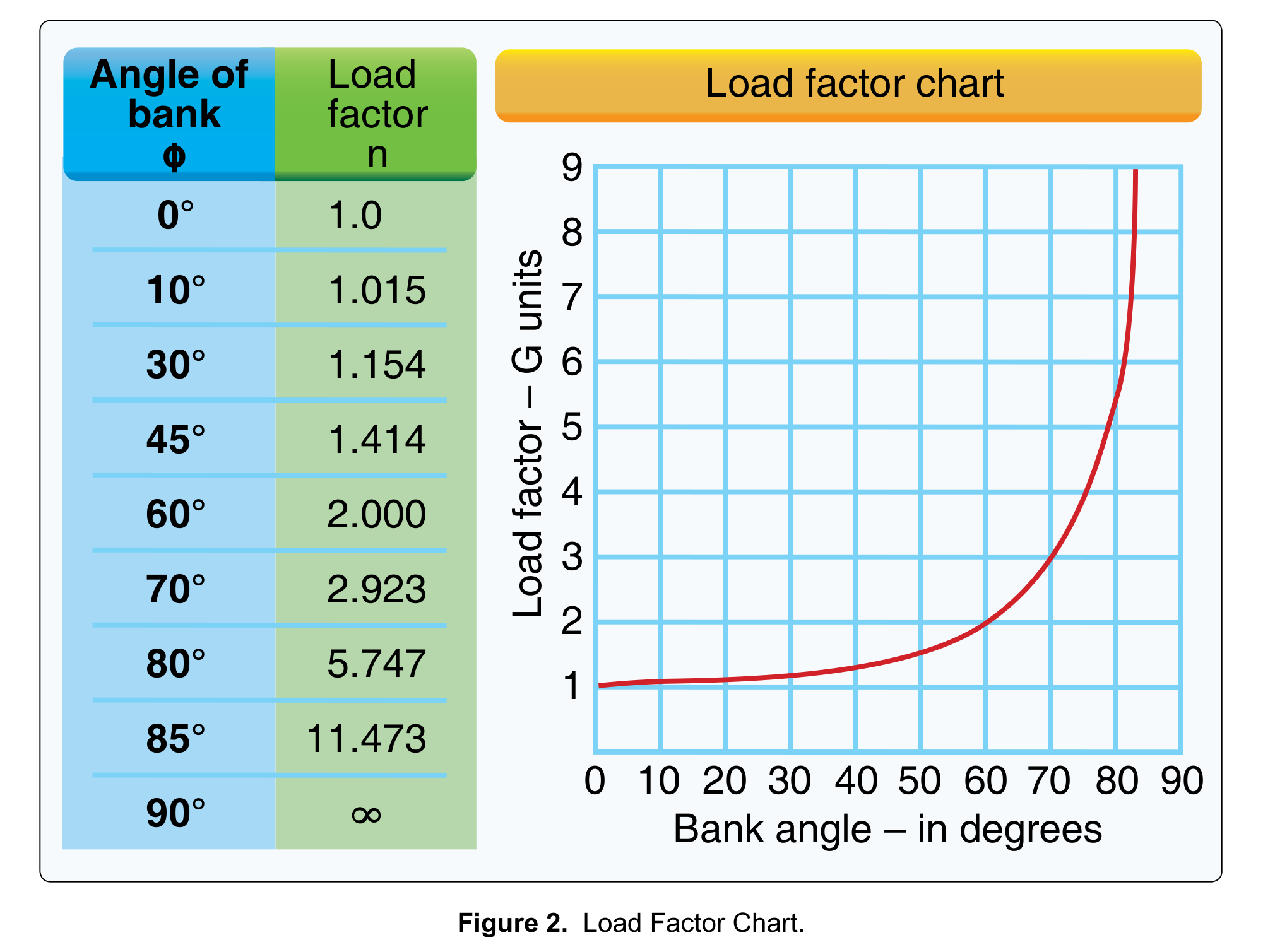
(Refer to FAA-CT-8080-2H, Figure 2.) The manufacturer of a fixed-wing small UA limits its structure to 3 Gs. In a coordinated, level turn, about what is the steepest bank angle that keeps the load factor at or below this limit?
Answer: B. About 70°
On the graph, the load factor curve reaches 3 Gs just past the 70° line, and the table confirms it: 70° gives 2.923, just under the limit, while 80° gives 5.747, nearly double it. The study guide likewise notes that banking more than 72° in a steep turn produces a load factor of 3. So about 70° is the steepest bank that stays within a 3 G limit, and 80° would exceed it badly. A 45° bank produces only 1.414 Gs; it is well within the limit but far from the steepest bank allowed. Because the curve rises so steeply beyond about 50°, a few extra degrees of bank near 70° add a lot of load.
Source
Figures 4-2 and 4-3 show that banking an aircraft greater than 72° in a steep turn produces a load factor of 3, and the stalling speed is increased significantly.
Figure 4-2 reveals an important fact about turns—the load factor increases at a terrific rate after a bank has reached 45° or 50°.
For pilots who already have a study routine.
$19one-time
Recommended
Build a routine, fix weak areas and rehearse the exam.
$39one-time
Add a printable reference for your final revision.
$59one-time
Already purchased? Restore or manage your access. Access lasts while this site operates.
Help us improve Part 107 HQ with page visits and feature-use counts. Your answers, scores, email and access code stay out of analytics. Privacy policy