Question Bank
For pilots who already have a study routine.
$19one-time
- All 765 practice questions
- Full explanations & official sources
- All 64 current-chart questions
- Topic drills & missed-question review
Operations questions are about flying safely around other aircraft and people: radio communications and traffic patterns at airports without a control tower, airport markings and signs, what to do in an emergency, aeronautical decision-making and crew resource management, physiological factors such as fatigue, medication and alcohol, and preflight inspection and maintenance.
25% of the test. That is the FAA weighting for this area since September 29, 2025 — about 15 of the 60 scored questions.
Most of these questions turn on understanding a handful of FAA concepts well, so the explanations focus on the idea behind the answer and point to the FAA handbook page that teaches it.
47 of the 177 questions in this area are free to read here. Try to answer before you open the explanation.
While monitoring a non-towered airport's frequency, you hear a pilot call "Millbrook UNICOM" and ask for wind and runway information. What kind of station is the pilot calling?
Answer: B. A nongovernment air/ground radio station that may provide airport information.
Per AIM 4-1-9(e), UNICOM is a nongovernment air/ground radio communication station that may provide airport information at public-use airports where there is no tower or FSS. On pilot request, a UNICOM station may give weather information, wind direction, the recommended runway, or other necessary information. It is not an FAA control tower: UNICOM is a nongovernment station, and this non-towered airport has no tower to issue takeoff or landing clearances. A continuous recorded weather broadcast describes ATIS, a one-way recording broadcast in selected high-activity terminal areas. Tip: "UNICOM" in a call means the pilot is talking to a ground station for airport information, not to an air traffic controller.
Source
UNICOM is a nongovernment air/ground radio communication station which may provide airport information at public use airports where there is no tower or FSS.
On pilot request, UNICOM stations may provide pilots with weather information, wind direction, the recommended runway, or other necessary information.
You are monitoring the radio near an airport whose control tower operates part-time. After the tower closes for the day, with no FSS on the airport, how should manned pilots announce their positions and intentions?
Answer: A. By self-announcing their position and intentions on the CTAF.
AIM 4-1-9(g)(2): if an airport has a tower that is temporarily closed or operated part-time, and there is no FSS on the airport or the FSS is closed, pilots use the CTAF to self-announce their position or intentions. Once the tower closes, the airport has no operating control tower, so nobody is there to issue clearances; asking the tower for a landing clearance is therefore wrong. Going silent is also wrong: the recommended practice is to keep communicating on the CTAF so other traffic knows who is where. For a remote pilot, the practical point is that after tower hours the frequency to monitor is the CTAF published for that airport.
Source
If an airport has a tower and it is temporarily closed, or operated on a part-time basis and there is no FSS on the airport or the FSS is closed, use the CTAF to self-announce your position or intentions.
A pilot near a non-towered airport transmits, "Traffic in the area, please advise." How does the AIM treat this phrase?
Answer: C. It is not a recognized self-announce phrase and should not be used.
AIM 4-1-9(g)(1) states that "Traffic in the area, please advise" is not a recognized Self-Announce Position and/or Intention phrase and should not be used under any condition. Self-announce means broadcasting your own position and intentions on the CTAF, not asking everyone else to talk, so it is not a standard request for position reports. Nothing in the AIM requires it on an initial call; the recommended inbound report at about 10 miles gives the aircraft's own identification, position, altitude, and intentions instead. For a remote pilot, the takeaway is that useful calls contain a position and an intention, such as "left downwind runway two seven," which you can turn into a picture of where the traffic is.
Source
Pilots stating, "Traffic in the area, please advise" is not a recognized Self-Announce Position and/or Intention phrase and should not be used under any condition.
Your small UA is operating south of a non-towered airport with a single runway, 18-36, and standard left traffic. You hear: "Cedar Valley traffic, Cessna Eight Four Two Tango Whiskey, departing runway one eight, remaining in the pattern, Cedar Valley." What path should you expect the airplane to fly?
Answer: A. Straight out to the south past the runway's south end, then a left turn toward the east onto crosswind.
An airplane departing runway 18 takes off toward about 180°, or south, so its departure end is the south end. AIM FIG 4-3-2 says to continue straight ahead until beyond the departure end and, if remaining in the pattern, to begin the turn to the crosswind leg beyond the departure end within 300 feet of pattern altitude. The crosswind leg is at right angles to the runway off its takeoff end (AIM 4-3-2), and with standard left traffic the turn from southbound is to the left, toward the east. A northbound climb-out would be a departure from runway 36. A right turn toward the west would be a right-hand pattern. Because the climb-out heads toward your area, scan south and be ready to yield.
Source
If remaining in the traffic pattern, commence turn to crosswind leg beyond the departure end of the runway within 300 feet of pattern altitude.
Crosswind leg. A flight path at right angles to the landing runway off its takeoff end.
Near a non-towered airport, you hear: "Millbrook traffic, Bonanza Six Seven Seven Papa Charlie, eight miles north, straight-in, runway one eight, Millbrook." What should you expect this airplane to do?
Answer: B. Approach from the north along the extended runway centerline without flying downwind or base.
The Pilot/Controller Glossary defines a VFR straight-in approach as entry into the traffic pattern by interception of the extended runway centerline (final approach course) without executing any other portion of the traffic pattern. Runway 18 is landed toward the south, so the airplane will come in from the north along the extended centerline. AIM 4-1-9(g)(4) asks pilots who choose a straight-in to self-announce about 8 to 10 miles out, as this pilot did, and notes they have no priority over aircraft in the pattern. Joining a left downwind is a normal pattern entry, not a straight-in. Approaching from the south and landing northbound would be runway 36. Watch the extended centerline north of the field.
Source
Entry into the traffic pattern by interception of the extended runway centerline (final approach course) without executing any other portion of the traffic pattern.
the pilot should self-announce their position on the designated CTAF approximately 8 to 10 miles from the airport
A light general aviation airplane, a Cessna 172, is registered N317GH. How would its pilot normally state the call sign on the CTAF?
Answer: B. Cessna Three One Seven Golf Hotel
AIM 4-2-4(a)(3) says civil pilots state the aircraft type, model, or manufacturer's name followed by the digits and letters of the registration, and when the manufacturer's name or model is stated, the prefix "N" is dropped. The Remote Pilot Study Guide adds that light GA aircraft usually use the manufacturer's name, so a Cessna 172 registered N123AB is "Cessna, One-Two-Three-Alpha-Bravo." Applied here, N317GH becomes "Cessna Three One Seven Golf Hotel," with each digit spoken separately and the letters in the phonetic alphabet. Keeping "November" after the make is wrong because the N is dropped. "Three Seventeen" uses group form, which the AIM describes for air carriers with FAA-authorized call signs, not for registration numbers.
Source
When the aircraft manufacturer's name or model is stated, the prefix "N" is dropped
Usually, when the aircraft is a light general aviation (GA) aircraft, the manufacturer's name will be used.
A manned pilot reports climbing to 13,500 feet MSL. How should that altitude be spoken on the radio?
Answer: A. One three thousand five hundred
AIM 4-2-8(b) says numbers above 9,900 are spoken by separating the digits preceding the word "thousand," and gives 13,500 as "one three thousand five hundred"; AIM 4-2-9(a) applies the same method to altitudes below 18,000 feet MSL. "Thirteen thousand five hundred" groups the digits in front of "thousand," which the AIM does not do. "Flight level" phraseology applies only at and above 18,000 feet MSL (FL 180), so it does not fit 13,500 feet. Recognizing these formats lets a remote pilot listening on a frequency quickly judge whether reported traffic is anywhere near the altitudes where small UA operate.
Source
Numbers above 9,900 must be spoken by separating the digits preceding the word "thousand."
At and above 18,000 feet MSL (FL 180), state the words "flight level" followed by the separate digits of the flight level.
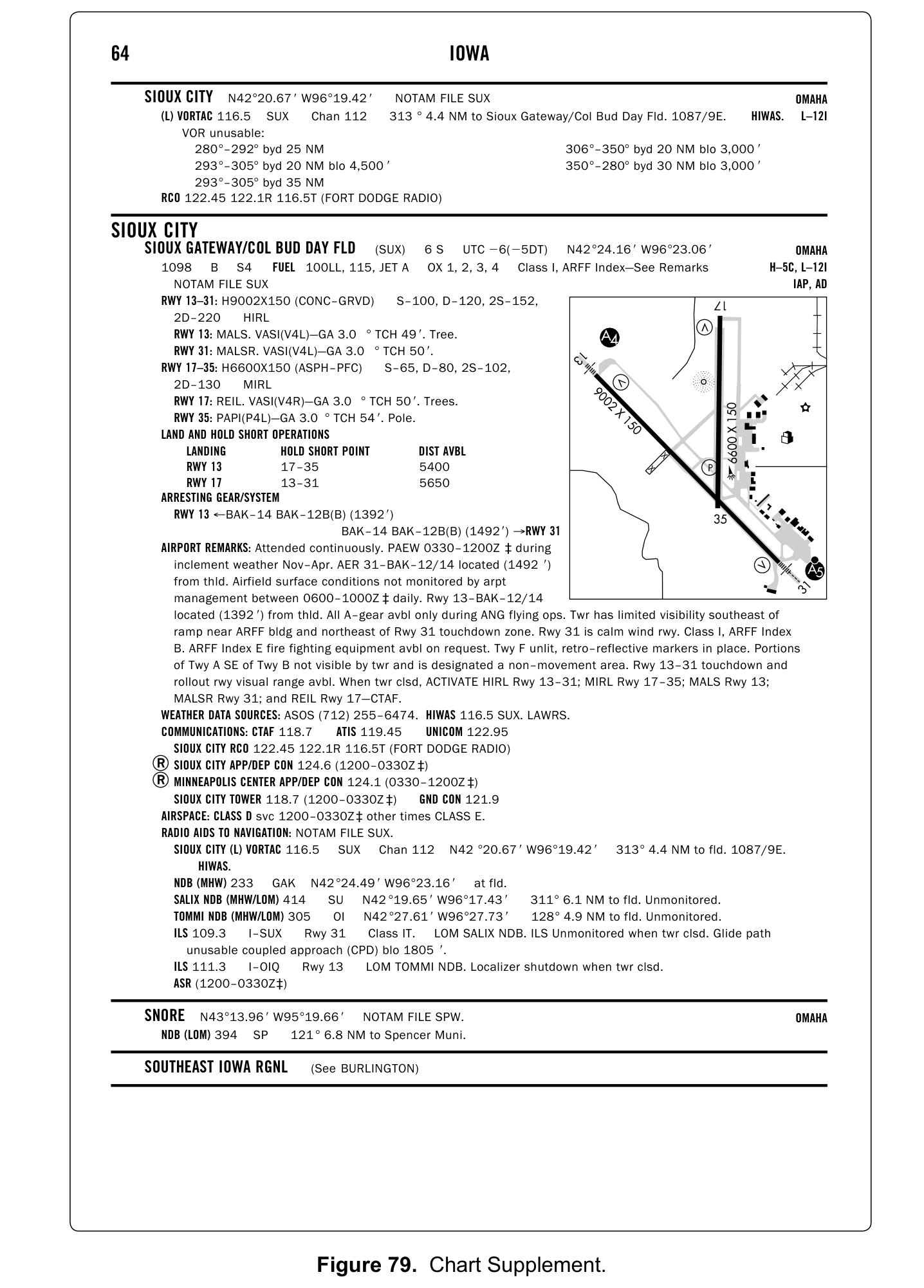
(Refer to FAA-CT-8080-2H, Figure 79.) You are planning work at Sioux Gateway/Col Bud Day Field (SUX) in July, when daylight saving time is in effect. During which hours is the Class D airspace at SUX in effect?
Answer: B. From 1100Z to 0230Z, one hour earlier than printed
The AIRSPACE line reads CLASS D svc 1200–0330Z‡ other times CLASS E. Chart Supplement times are UTC, and the ‡ symbol, explained in the Chart Supplement legend (Legend 4), means that during daylight saving time the effective hours are one hour earlier than shown; the FAA Chart Users' Guide states the same convention in its enroute chart time-zone note. July falls within daylight saving time, so the Class D is in effect from 1100Z to 0230Z: the tower keeps the same local schedule, but local clocks are one hour closer to UTC. Using 1200Z to 0330Z ignores the ‡, and 1300Z to 0430Z shifts the hours the wrong way. Outside those hours the surface area is Class E, which still requires ATC authorization for a Part 107 flight.
Source
AIRSPACE: CLASS D svc 1200-0330Z‡ other times CLASS E.
During periods of Daylights Savings Time (DT), effective hours will be one hour earlier than shown.
When Daylight Saving Time is in effect, generally between the second Sunday in March and the first Sunday in November
Part-time Class D effective times are published in the Chart Supplement.
(Refer to FAA-CT-8080-2H, Figure 79.) You are working near Sioux Gateway/Col Bud Day Field (SUX) on a day with calm wind. Based on the airport remarks, from which direction should you expect manned airplanes to approach to land?
Answer: A. From the southeast, flying northwest toward runway 31
The airport remarks state Rwy 31 is calm wind rwy. Runway numbers come from the approach direction: runway 31 is aligned with a magnetic azimuth of about 310°, so airplanes landing on it fly toward the northwest and are on final approach southeast of the field. Reading the number as the side the approach comes from reverses the picture; northwest of the field is where airplanes departing runway 31 climb out, not where arrivals descend. The remark exists because the airport has designated a preferred runway for calm conditions, so "any direction" is wrong. In calm wind, expect low, descending traffic along the extended centerline southeast of runway 31.
Source
Rwy 31 is calm wind rwy.
Runway numbers and letters are determined from the approach direction. The runway number is the whole number nearest one-tenth the magnetic azimuth of the centerline of the runway, measured clockwise from the magnetic north.
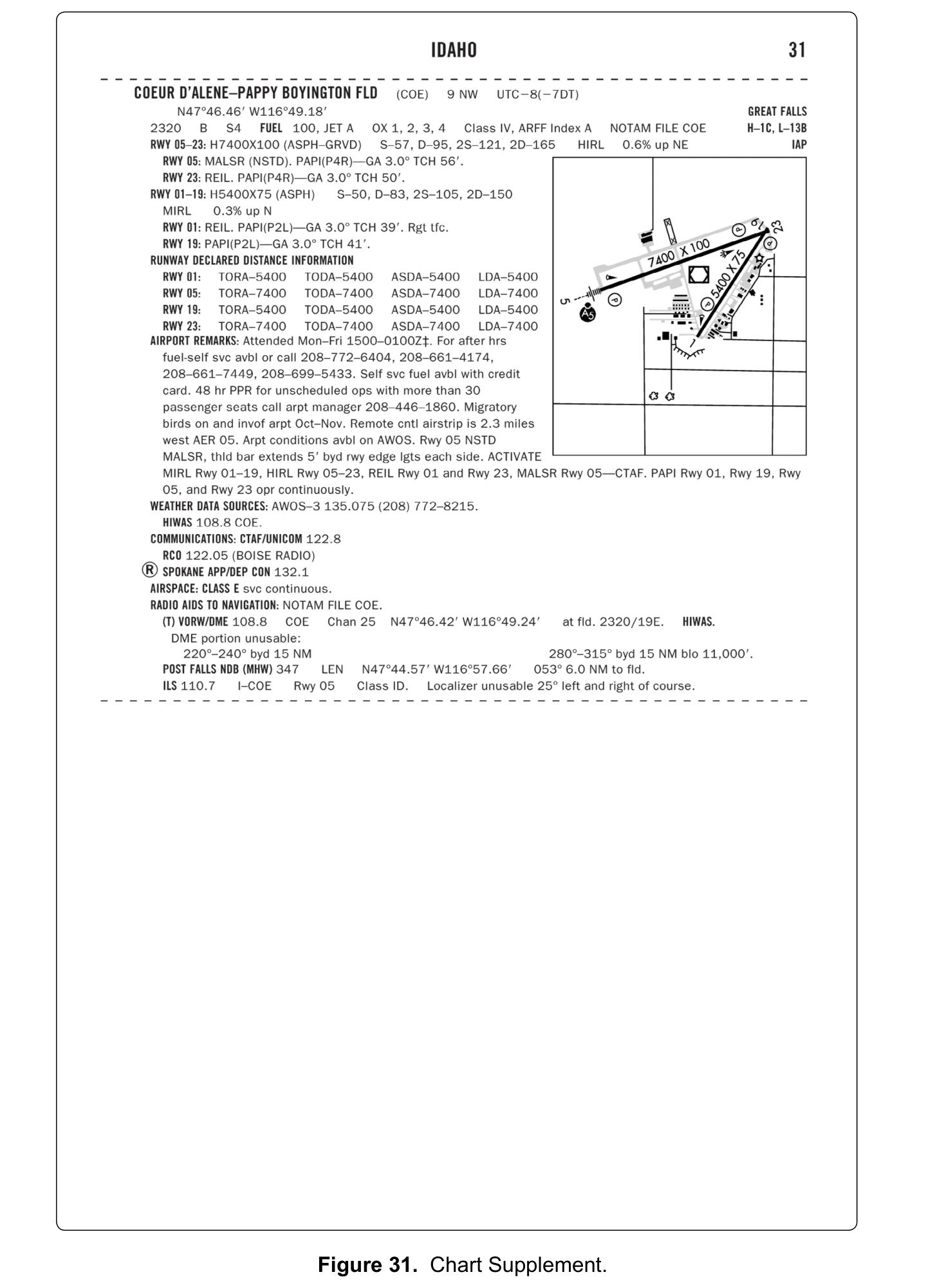
(Refer to FAA-CT-8080-2H, Figure 31.) Before a job near Coeur d'Alene–Pappy Boyington Field (COE), you plan to call the automated weather system listed under WEATHER DATA SOURCES. Which information should that system provide?
Answer: B. Wind, temperature, dew point, altimeter setting, density altitude, visibility, and cloud height
The COE entry lists AWOS-3 135.075 (208) 772-8215, so you can listen on 135.075 MHz or call the phone number. The Aviation Weather Handbook describes AWOS-1 as reporting wind, temperature, dew point, altimeter setting, and density altitude; AWOS-2 adds visibility; and AWOS-3 reports everything an AWOS-2 does plus cloud height (and precipitation accumulation). A system that reports only the altimeter setting, with everything else advisory, is an AWOS-A. A report with no visibility or cloud data describes an AWOS-1. For a remote pilot, the AWOS-3's visibility and cloud information helps judge whether the 3-statute-mile visibility and cloud clearance minimums of 14 CFR 107.51 are likely to be met near the airport.
Source
AWOS-1: The AWOS-1 system measures and reports wind data (e.g., speed, direction, and gusts; temperature; dewpoint; altimeter; and density altitude).
AWOS-2: The AWOS-2 system measures and reports all of the parameters of an AWOS-1 system plus visibility.
AWOS-3: The AWOS-3 system measures and reports all of the parameters of an AWOS-2 system plus precipitation accumulation (rain gauge) and cloud height.
AWOS-A only reports altimeter setting; NOTE-Any other information is advisory only.
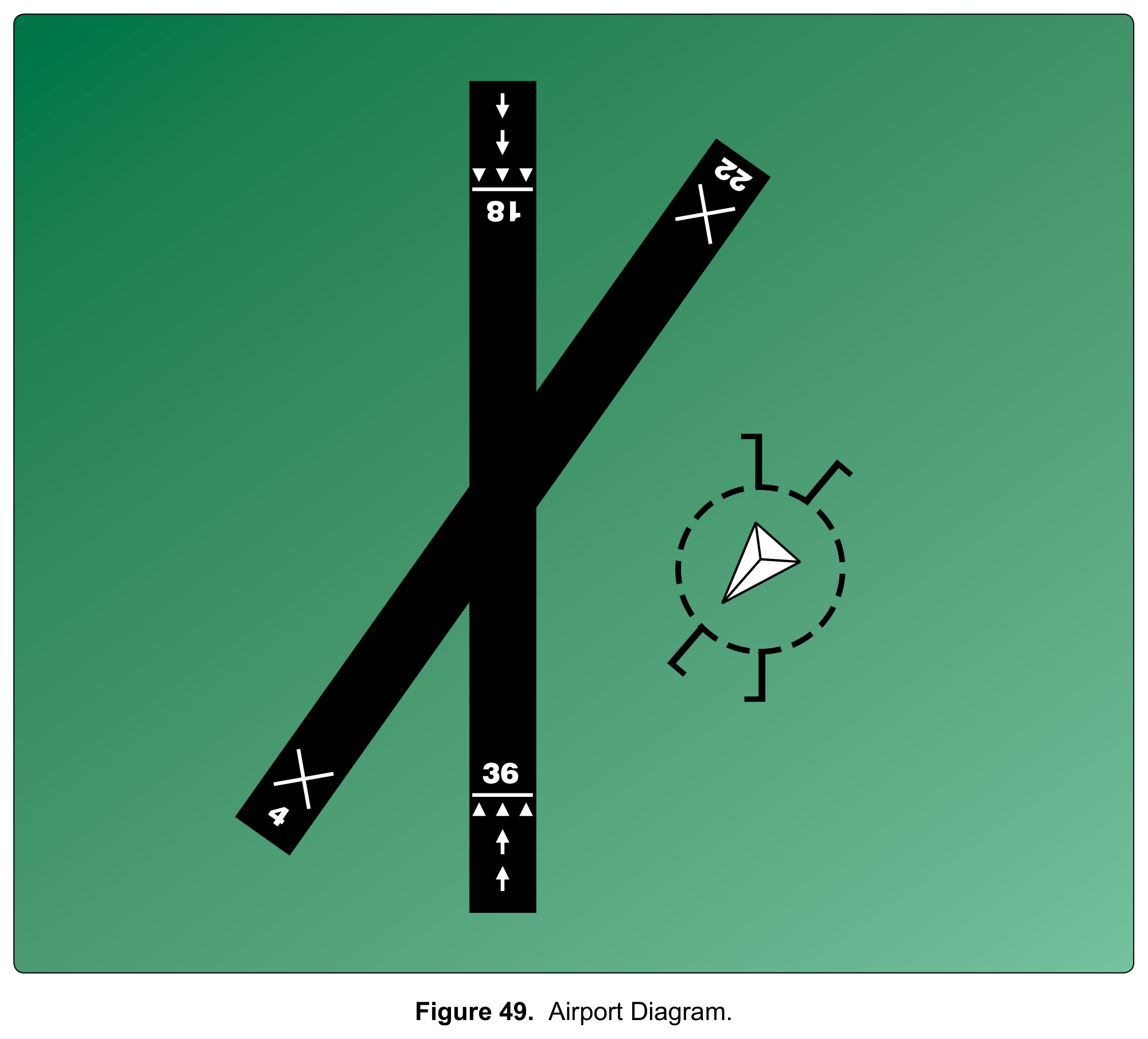
(Refer to FAA-CT-8080-2H, Figure 49.) You plan a flight near this airport. According to the traffic pattern indicators at the segmented circle, where will manned airplanes fly the traffic pattern for runway 18 and for runway 36?
Answer: B. West of runway 18-36 for both runway directions
Pilots use the indicator at the approach end of the runway to be used and mentally enlarge it: the long leg is the final approach and the short leg is the base leg. The indicator north of the circle serves runway 18, and its short leg points west, so airplanes turn right from base to final and fly the pattern west of the runway. The indicator south of the circle serves runway 36; its short leg also points west, giving a left-hand pattern that is again west of the runway. Putting runway 18's pattern on the east side assumes standard left traffic and ignores the indicators, and putting both patterns east reverses the reading. Runway 4-22 is marked with an X at each end, so it is closed.
Source
Traffic pattern indicators. Arranged in pairs in conjunction with landing strip indicators and used to indicate the direction of turns when there is a variation from the normal left traffic pattern.
Preparatory to landing at an airport without a control tower, or when the control tower is not in operation, pilots should concern themselves with the indicator for the approach end of the runway to be used.
If the pilot will mentally enlarge the indicator for the runway to be used, the base and final approach legs of the traffic pattern to be flown immediately become apparent.
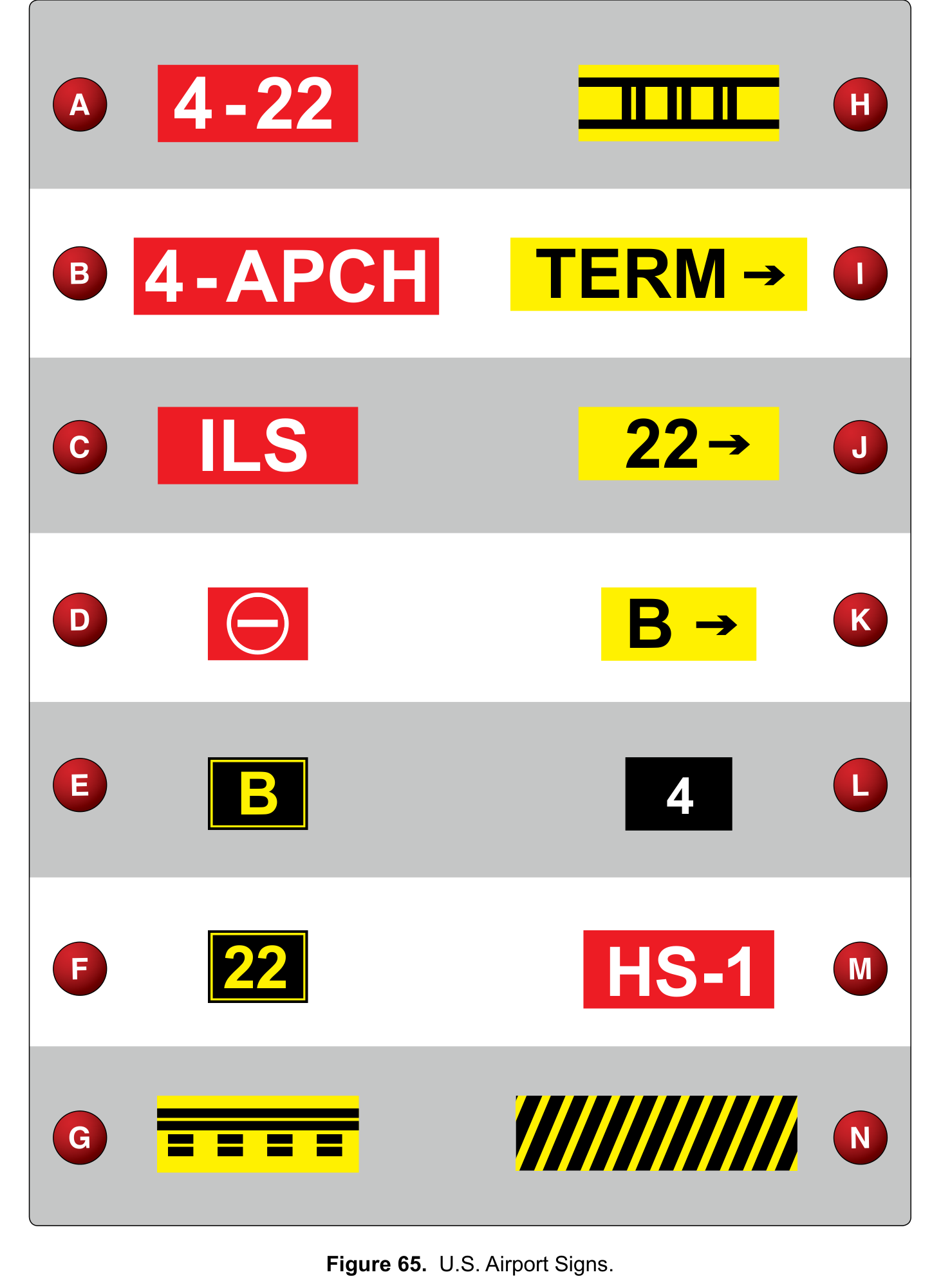
(Refer to FAA-CT-8080-2H, Figure 65.) What does sign D, a white circle with a horizontal bar on a red background, tell a pilot?
Answer: A. Aircraft are prohibited from entering the area beyond the sign.
Sign D is the no entry sign, one of the mandatory instruction signs with a red background. The AIM says this sign prohibits an aircraft from entering an area; it is typically found on a taxiway intended for one-way use, or where a vehicle roadway meets runways, taxiways, or aprons and could be mistaken for a taxiway. It does not report a runway closure; a closed runway is marked with crosses at each end. Nor is it a hold-short instruction for crossing traffic: holding positions are marked with holding position signs, such as the red 4-22 runway holding position sign, sign A. The no entry sign forbids entering the area at all rather than asking the pilot to wait.
Source
No Entry Sign. This sign, shown in FIG 2-3-29, prohibits an aircraft from entering an area.
Typically, this sign would be located on a taxiway intended to be used in only one direction or at the intersection of vehicle roadways with runways, taxiways, or aprons
With ATC authorization, you are operating near a towered airport while monitoring the tower frequency. You hear: "Cessna Four Two Lima, proceed southwestbound, enter a right downwind, runway three one." Where will that airplane fly its downwind leg?
Answer: A. Northeast of the runway, flying southeast.
Runway 31 is aligned with about 310° magnetic, so landings are toward the northwest. The downwind leg is flown parallel to the landing runway in the opposite direction of landing (AIM 4-3-2), about 130°, or southeast. In a right-hand pattern the turns are to the right, so the pattern lies on the right side of a northwest-bound landing, which is the northeast side. That fits the instruction to proceed southwestbound, too: the airplane is arriving from the northeast. Southwest of the runway would be a left downwind. Flying northwest is the landing direction, not downwind. AIM 4-3-2(d)(3) shows towers giving exactly this kind of generalized instruction, which is why monitoring the tower frequency helps you predict where traffic will be.
Source
The local controller may provide pilots flying VFR with generalized instructions which will facilitate operations
Downwind leg. A flight path parallel to the landing runway in the opposite direction of landing.
What does the number of runway 27 tell you about that runway?
Answer: B. Its centerline is aligned with about 270° magnetic.
AIM 2-3-3(b) states that the runway number is the whole number nearest one-tenth of the magnetic azimuth of the runway centerline, measured clockwise from magnetic north, so runway 27 points about 270° magnetic (roughly west). The PHAK confirms that runway numbers are in reference to magnetic north. True north is not used, which is convenient because wind given by the tower is also magnetic and can be compared directly with the runway number. The number says nothing about the runway's length. Tip: add a zero to the runway number to get its approximate magnetic direction.
Source
The runway number is the whole number nearest one-tenth the magnetic azimuth of the centerline of the runway, measured clockwise from the magnetic north.
Runway numbers are in reference to magnetic north.
Which color scheme identifies a mandatory instruction sign, such as a runway holding position sign?
Answer: B. White inscription on a red background
AIM 2-3-8(a) states that mandatory instruction signs have a red background with a white inscription and denote an entrance to a runway or critical area, or an area where aircraft are prohibited from entering. A runway holding position sign is the most common example; the PHAK calls it the airport version of a stop sign. Black on yellow is used for direction, destination, and information signs. Yellow on black, with a yellow border, is used for taxiway and runway location signs, which identify the taxiway or runway an aircraft is on. Tip: red means stop or do not enter, just as on the road.
Source
These signs have a red background with a white inscription and are used to denote:
runway holding position sign is an airport version of a stop sign.
At a taxiway entrance to a runway, there is a red sign with the white inscription "4-22." What does the arrangement of the numbers tell a pilot facing the sign?
Answer: B. The threshold of runway 4 is to the left, and the threshold of runway 22 is to the right.
A red sign with white numbers is a runway holding position sign, a mandatory instruction sign. AIM 2-3-8(b)(1) explains that the runway numbers on it are arranged to correspond to the respective runway thresholds; its example "15-33" means the threshold for runway 15 is to the left and the threshold for runway 33 is to the right. Likewise, "4-22" means the runway 4 threshold is to the left and the runway 22 threshold is to the right. Reversing the sides misreads the arrangement. Runways 4 and 22 are the two ends of one runway, aligned with about 040° and 220°, not two intersecting runways. Signs like this mark where aircraft must stop before entering the runway.
Source
The runway numbers on the sign are arranged to correspond to the respective runway threshold.
For example, "15-33" indicates that the threshold for Runway 15 is to the left and the threshold for Runway 33 is to the right.
At an airport without an operating control tower, what do the traffic pattern indicators on the segmented circle show?
Answer: A. The direction of turns when the pattern differs from the normal left-hand pattern
AIM 4-3-4 explains that a segmented circle, where installed at an airport without an operating control tower, is designed to provide traffic pattern information. Its traffic pattern indicators are arranged in pairs with the landing strip indicators and show the direction of turns when there is a variation from the normal left traffic pattern; if there is no segmented circle, they may be installed on or near the end of the runway. Wind direction comes from the wind sock, wind cone, or wind tee, which may sit in the center of the circle. Closed runways are shown by yellow crosses on the runway itself. For a remote pilot, these indicators reveal on which side of each runway to expect pattern traffic.
Source
Arranged in pairs in conjunction with landing strip indicators and used to indicate the direction of turns when there is a variation from the normal left traffic pattern.
At those airports without an operating control tower, a segmented circle visual indicator system, if installed, is designed to provide traffic pattern information.
At dusk you notice an airport beacon that shows two quick white flashes between each green flash. What type of airport is it?
Answer: A. A military airport
AIM 2-1-9(c) states that military airport beacons flash alternately white and green but are differentiated from civil beacons by dual-peaked (two quick) white flashes between the green flashes. The PHAK lists the same signal: two quick white flashes alternating with a green flash identify a military airport. A heliport beacon shows green, yellow, and white, and a water airport beacon shows white and yellow; neither matches a white-and-green display. Recognizing the code tells a remote pilot that the nearby field is a military airport, so expect its traffic in the area.
Source
Military airport beacons flash alternately white and green, but are differentiated from civil beacons by dualpeaked (two quick) white flashes between the green flashes.
Two quick white flashes alternating with a green flash identifying a military airport
At dusk, while monitoring the CTAF of a non-towered airport, you hear seven rapid microphone clicks, and the runway lights come on at full brightness. What happened?
Answer: A. A pilot activated pilot-controlled lighting by keying the microphone seven times within five seconds.
AIM 2-1-8 describes pilot-controlled lighting: at selected airports, pilots turn on airport lights from the air by keying the aircraft's microphone, and keying it 7 times within 5 seconds selects the highest intensity available (TBL 2-1-3). The lights stay on for 15 minutes from the most recent activation. AIM 4-1-10(c) adds that, whenever possible, the CTAF is used to control the lighting at airports without operating control towers. Lights coming on is the opposite of a closure signal, and the AIM describes no emergency click code. Because pilots are told to key the mike when overflying the airport of intended landing or before the final segment of an approach, the clicks suggest a manned aircraft is nearby and may be preparing to land.
Source
Radio control of lighting is available at selected airports to provide airborne control of lights by keying the aircraft's microphone.
7 times within 5 seconds Highest intensity available
Whenever possible, the CTAF will be used to control airport lighting systems at airports without operating control towers.
How often is the Chart Supplement U.S. revised?
Answer: C. Every 56 days
The Remote Pilot Study Guide (Chapter 11) states that the Chart Supplement U.S. is published in seven books organized by region and is revised every 56 days; the Pilot/Controller Glossary likewise describes the Chart Supplement series as issued by the FAA every 56 days. Every six months and once a year are both far longer than the actual cycle, and relying on an edition that old risks missing changed frequencies, runway information, or other airport data. Before planning work near an airport, make sure you are using the current edition; the study guide notes it is also available digitally on the FAA website.
Source
The Chart Supplement U.S. is published in seven books, which are organized by regions and are revised every 56 days.
A series of civil/military flight information publications issued by FAA every 56 days consisting of the Chart Supplement U.S., Chart Supplement Alaska, and Chart Supplement Pacific.
Before a complex inspection with two visual observers, a remote PIC wants the crew to respond quickly and consistently if something goes wrong. Which mitigation listed in AC 107-2A addresses this?
Answer: B. Define and brief the criteria for ending the flight, and who will make and execute that decision.
AC 107-2A, paragraph A.4.4, lists items to consider when formulating mitigations, including clearly defining and briefing criteria that could cause the discontinuation of the flight, such as items that affect safety of flight, and who will make and execute decisions. Agreeing on these points before launch lets the crew act without hesitation. Leaving the response to whoever notices first invites confusion; visual observers report hazards so the remote PIC can act, and the remote PIC remains the final authority as to the operation (§ 107.19(b)). Criteria agreed only at the debriefing come too late to help during the flight.
Source
Clearly define and brief criteria that could cause the discontinuation of the flight (e.g., items that affect safety of flight) and who will make and execute decisions.
The remote pilot in command is directly responsible for and is the final authority as to the operation of the small unmanned aircraft system.
Before a 25-minute flight, a remote PIC confirms the aircraft battery is fully charged but notices the control station battery is nearly empty. He reasons that only the aircraft needs power for the flight. Why is his reasoning wrong?
Answer: C. The control station is part of the small UAS, and losing its power is a listed cause of a lost link.
Under § 107.3, a small UAS includes the aircraft and its associated elements, including the communication links and the components that control the aircraft, and § 107.49(d) requires enough available power for the small unmanned aircraft system to operate for the intended operational time. AC 107-2A's sample risk assessment lists loss of power supply from the control station as a cause of losing the control link, and its preflight items include checking battery levels for both the aircraft and the control station. The control station does not power the aircraft's motors, and part 107 sets no fully-charged requirement; it requires enough power for the intended operation.
Source
Small unmanned aircraft system (small UAS) means a small unmanned aircraft and its associated elements (including communication links and the components that control the small unmanned aircraft)
If the small unmanned aircraft is powered, ensure that there is enough available power for the small unmanned aircraft system to operate for the intended operational time
Loss of power supply from control station, small UAS out of range, signal interference from another device (Wi-Fi, Bluetooth, etc.)
Check battery levels for the aircraft and CS.
While the remote PIC watches the aircraft hover steadily in place, the moving map suddenly shows a large jump in its GPS position. According to the AIM, what can this indicate?
Answer: B. Possible GPS jamming or spoofing affecting the aircraft.
The AIM (paragraph 1-2-4) lists a large shift in displayed GPS position among the possible indications of GPS jamming or spoofing, along with incorrect positions and clock changes. It advises pilots to be vigilant for any indication that GPS is disrupted, to assess the operational risks and limitations linked to losing GPS capability, and to be prepared to operate without GPS. Treating a large position jump as routine ignores exactly the warning sign the AIM describes, and nothing in the guidance links such a jump to compass calibration. Because the remote PIC can see the aircraft is not moving, the displayed position is clearly wrong.
Source
Be vigilant for any indication that the aircraft's GPS is disrupted
Large shift in displayed GPS position.
Assess operational risks and limitations linked to the loss of GPS capability
Pilots should also be prepared to operate without GPS navigation systems.
During a visual line-of-sight flight without a visual observer, the aircraft's GPS signal degrades and the moving map on the control station begins showing an inaccurate position. How must the remote PIC keep track of where the aircraft is?
Answer: C. By seeing the aircraft with vision unaided by any device other than corrective lenses.
Under § 107.31(a), the remote PIC, the visual observer if one is used, and the person manipulating the controls must be able to see the aircraft, with vision unaided by any device other than corrective lenses, throughout the flight in order to know its location and determine its attitude, altitude, and direction of flight; with no visual observer, the remote PIC must exercise that ability (§ 107.31(b)). GPS does not replace that requirement: the AIM (paragraph 1-2-4) lists inaccurate aircraft position on navigation displays among the impacts of GPS jamming or spoofing. A stale map position is unreliable, and AC 107-2A, paragraph 5.9.1, allows binoculars only momentarily, not for continuous tracking.
Source
With vision that is unaided by any device other than corrective lenses
must be able to see the unmanned aircraft throughout the entire flight in order to: (1) Know the unmanned aircraft's location;
Inaccurate aircraft position on navigation display (e.g., moving map and electronic flight bag).
Vision aids, such as binoculars, may be used only momentarily to enhance situational awareness.
the ability described in paragraph (a) of this section must be exercised by either:
To save time, a remote pilot charges his aircraft's lithium battery on an unfamiliar fast charger instead of the one the manufacturer recommends. According to AC 107-2A, why is this a concern?
Answer: C. Improper charging can cause a fire; the AC advises following manufacturer recommendations.
AC 107-2A, paragraph B.5, lists improper charging among the causes of lithium battery fires, along with short circuits, extreme heat, crash damage, mishandling, and defects, and says the remote PIC should consider following the manufacturer's recommendations, when available, to help ensure safe battery handling and usage. Using a charger the manufacturer does not recommend departs from that guidance and risks improper charging. Charging is not only a battery-life issue, and fires are not limited to crash damage. The same paragraph warns that lithium-based batteries are highly flammable and that a battery fire could cause an in-flight emergency.
Source
Lithium battery fires can be caused when a battery short-circuits, is improperly charged, is heated to extreme temperatures
The remote PIC should consider following the manufacturer's recommendations, when available, to help ensure safe battery handling and usage.
A remote pilot skips inspecting his batteries, reasoning that battery fires and flyaways happen to other operators but will never happen to him. Which hazardous attitude is he showing?
Answer: C. Invulnerability
Believing that accidents happen to others but never to oneself is the invulnerability attitude ("It won't happen to me"). The PHAK (p. 2-5) notes that pilots who think this way are more likely to take chances and increase risk; skipping a battery inspection is one such chance. Its antidote is "It could happen to me." Resignation ("What's the use?") is feeling unable to make a difference and leaving the action to others, and impulsivity ("Do it quickly") is acting on the first idea without stopping to think; neither matches a belief in personal immunity from accidents.
Source
Many people falsely believe that accidents happen to others, but never to them.
Pilots who think this way are more likely to take chances and increase risk.
A remote pilot uses a risk matrix to rate a hazard before a flight. Which two items does the risk matrix assess?
Answer: B. The likelihood of an event occurring and the severity of its consequences.
The PHAK (p. 2-6) calls the risk matrix the most basic risk assessment tool and says it assesses two items: the likelihood of an event occurring and the consequence (severity) of that event. AC 107-2A, Appendix A, uses the same idea, defining risk as the combination of likelihood and severity. Flight hours, aircraft age, wind, and density altitude can all be hazards or factors worth considering, but they are things you would rate with the matrix, not its two dimensions. Tip: risk = how likely combined with how bad.
Source
It assesses two items: the likelihood of an event occurring and the consequence of that event.
Combination of Likelihood and Severity
The crew tells a remote PIC that the job site is inside Class D airspace and needs an ATC authorization. He replies that nobody is going to tell him where he can fly his own drone and launches anyway. Which hazardous attitude is he displaying?
Answer: A. Anti-authority
Resenting being told what to do and treating rules as unnecessary is the anti-authority attitude ("Don't tell me"); the PHAK (p. 2-5) describes people who are, in a sense, saying "No one can tell me what to do." Its antidote is "Follow the rules. They are usually right." Macho ("I can do it") is taking risks to prove oneself or impress others, and invulnerability ("It won't happen to me") is the belief that accidents happen only to others; neither is the motive he states. The attitude leads straight to a violation, because § 107.41 requires prior ATC authorization to operate in Class D airspace.
Source
This attitude is found in people who do not like anyone telling them what to do. In a sense, they are saying, "No one can tell me what to do."
No person may operate a small unmanned aircraft in Class B, Class C, or Class D airspace
As the wind increases and the aircraft starts drifting toward trees, the remote PIC decides nothing she does will change the outcome, blames bad luck for the whole job, and leaves it to the visual observer to decide what to do. Which hazardous attitude is this?
Answer: C. Resignation
Resignation ("What's the use?") describes pilots who do not see themselves as able to make much difference in what happens to them; the PHAK (p. 2-5) says they attribute bad outcomes to bad luck and leave the action to others, for better or worse. The antidote is "I'm not helpless. I can make a difference." Leaving the decision to the visual observer does not shift responsibility, because the remote PIC is directly responsible for and the final authority as to the operation (§ 107.19(b)). Invulnerability is believing accidents will not happen to you, and macho is taking risks to impress others.
Source
When things go badly, the pilot may feel that someone is out to get them or attribute it to bad luck. The pilot will leave the action to others, for better or worse.
The remote pilot in command is directly responsible for and is the final authority as to the operation of the small unmanned aircraft system.
While processing hazards with the CARE checklist, a remote pilot catches himself thinking the gusty winds will "probably" be okay. What does the PHAK say this should signal?
Answer: C. That it is time for a solid reality check.
In the 3P model, the Process step uses the CARE checklist: Consequences, Alternatives, Reality, External factors. The PHAK (p. 2-16) gives a rule of thumb for this phase: if you find yourself saying that it will "probably" be okay, it is definitely time for a solid reality check. Treating "probably" as acceptance skips the very evaluation CARE is meant to force. Handing the question to the visual observer is not a reality check, and the remote PIC remains the final authority for the operation (§ 107.19(b)). The PHAK also warns that schedule pressure can affect both the go/no-go decision and in-flight decisions.
Source
if you find yourself saying that it will "probably" be okay, it is definitely time for a solid reality check.
They can process hazards by using the CARE checklist of: Consequences, Alternatives, Reality, External factors.
During a job, a new visual observer spots a helicopter approaching but hesitates to speak up because he does not want to second-guess the remote PIC. Which CRM characteristic is missing from this crew?
Answer: B. An environment in which open communication is encouraged and expected.
AC 107-2A, paragraph A.2.5, says a characteristic of CRM is creating an environment where open communication is encouraged and expected and that involves the entire crew to maximize team performance. Crewmembers such as visual observers provide information about traffic, airspace, and weather, and the VO is expected to communicate flight status and any hazards to the remote PIC so appropriate action can be taken. A second control station is a way for a remote PIC to supervise someone else on the controls, not a tool for the VO, and no FAA approval is needed for a crewmember to report a hazard. The remote PIC's briefing should make speaking up the norm.
Source
A characteristic of CRM is creating an environment where open communication is encouraged and expected, and involves the entire crew to maximize team performance.
communicate flight status and any hazards to the remote PIC and person manipulating the controls so that appropriate action can be taken
A remote PIC will station a visual observer about 300 yards away beside a noisy generator. According to AC 107-2A, how should the crew's communication be handled?
Answer: A. Agree on an effective, non-distracting method, such as handheld radios, before the flight.
AC 107-2A (paragraphs 5.9.2.2 and A.2.5.2) says the remote PIC, person manipulating the controls, and visual observer must work out a method of communication, such as a handheld radio or other effective means, that does not create a distraction and lets them understand each other, and the remote PIC should make that determination prior to flight. Waiting until a hazard appears is too late. Communication-assisting devices such as handheld radios are expressly permitted, and shouting across 300 yards beside a generator would not provide the constant ability to understand one another. Under § 107.33(a), the crew must maintain effective communication at all times.
Source
must work out a method of communication, such as the use of a handheld radio or other effective means that would not create a distraction and allows them to understand each other
The remote PIC should evaluate which method is most appropriate for the operation and should make a determination prior to flight.
Effective communication would permit the use of communication-assisting devices, such as a handheld radio, to facilitate communication from a distance.
must maintain effective communication with each other at all times.
Rushing to meet a client's deadline while juggling several tasks, a remote pilot becomes absorbed in troubleshooting a flickering readout on the controller and stops watching the aircraft and the surrounding airspace. According to the PHAK, what is happening?
Answer: A. Stress and workload are causing fixation on one item, which reduces overall situational awareness.
The PHAK (p. 2-24) lists fatigue, stress, and work overload as obstacles to situational awareness because they can cause a pilot to fixate on a single perceived important item. It adds that a distraction diverting the pilot's attention is a contributing factor in many accidents, and that many such distractions begin as a minor problem, such as a gauge that is not reading correctly. Maintaining awareness requires an overview of the whole operation, so fixating on one readout is not recommended, and pressure beyond the ability to cope degrades performance rather than sharpening it. AC 107-2A notes that a visual observer can watch the aircraft while the remote PIC checks displays.
Source
Fatigue, stress, and work overload can cause a pilot to fixate on a single perceived important item and reduce an overall situational awareness of the flight.
A contributing factor in many accidents is a distraction that diverts the pilot's attention from monitoring the instruments or scanning outside the aircraft.
begins to fall off rapidly as stress levels exceed a person's ability to cope
using one or more VOs allows the remote PIC and person manipulating the controls to conduct other mission-critical duties (such as checking displays) while still ensuring situational awareness
A remote PIC will film near an accident scene from an obvious takeoff and landing spot. During planning she asks, "What if an EMS helicopter needs this same area while my battery is running low?" Following the AC 107-2A example, which mitigation fits?
Answer: A. Plan an alternate landing site, plus sites where the aircraft could be sacrificed to protect people and aircraft.
AC 107-2A, paragraph A.4.8.1, uses this scenario to illustrate hazard identification. By asking "what if?" before flight, the remote PIC might reach an acceptable level of risk by also having an alternate landing site and possibly additional sites at which the aircraft can be sacrificed to avoid imposing risks on people on the ground or on manned aircraft. Expecting the helicopter to wait is backwards: under § 107.37(a), each small unmanned aircraft must yield the right of way to all aircraft. Hovering indefinitely on a low battery ignores the very hazard the planning identified.
Source
What if, while I am operating, a manned aircraft (emergency medical services (EMS) helicopter) requires use of the same area and I am not left with a suitable landing site?
an acceptable level of risk can be achieved by also having an alternate landing site and possibly additional sites at which I can sacrifice the small unmanned aircraft
Each small unmanned aircraft must yield the right of way to all aircraft, airborne vehicles, and launch and reentry vehicles.
According to FAA guidance, what is the first noticeable effect of dehydration?
Answer: B. A feeling of fatigue.
The PHAK (Chapter 17, p. 17-14) and the Remote Pilot Study Guide (Chapter 9, p. 47) state that the first noticeable effect of dehydration is fatigue, which makes top physical and mental performance difficult, if not impossible. Extreme thirst and tingling of the hands and feet are real effects, but they come later: if the lost fluid is not replaced, fatigue progresses to dizziness, weakness, nausea, tingling of hands and feet, abdominal cramps, and extreme thirst. Tip: on a long, hot day in the field, treat unexplained tiredness as an early cue to drink water instead of waiting to feel thirsty.
Source
The first noticeable effect of dehydration is fatigue, which in turn makes top physical and mental performance difficult, if not impossible.
If this fluid is not replaced, fatigue progresses to dizziness, weakness, nausea, tingling of hands and feet, abdominal cramps, and extreme thirst.
Which statement about heatstroke is correct?
Answer: A. It is caused by the body's inability to control its temperature and may be noticed only when the person collapses.
The Remote Pilot Study Guide (Chapter 9, p. 48) and the PHAK (p. 17-14) define heatstroke as a condition caused by any inability of the body to control its temperature. Its onset may be recognized by the symptoms of dehydration, but it has also been recognized only upon complete collapse, so there may be no clear early warning. Rapid breathing that lowers carbon dioxide describes hyperventilation, not heatstroke. Water does not cause heatstroke, and waiting for thirst is the opposite of FAA advice: carry an ample supply of water and drink it at frequent intervals, whether thirsty or not.
Source
Heatstroke is a condition caused by any inability of the body to control its temperature. Onset of this condition may be recognized by the symptoms of dehydration, but also has been known to be recognized only upon complete collapse.
To prevent these symptoms, it is recommended that an ample supply of water be carried and used at frequent intervals, whether thirsty or not.
During an unexpected flyaway, a remote pilot notices that he feels lightheaded, his fingers are tingling, and he is breathing quickly. What should he do about these symptoms?
Answer: A. Consciously slow his breathing rate; talking aloud can also help.
Lightheadedness and tingling during a sudden stressful event are classic signs of hyperventilation (Remote Pilot Study Guide, Chapter 9, pp. 45-46; PHAK pp. 17-4 to 17-5). Treatment restores the proper carbon dioxide level: breathing normally is both the best prevention and the best cure, and in addition to slowing the breathing rate, breathing into a paper bag or talking aloud helps. Recovery is usually rapid once the breathing rate returns to normal. Breathing faster and deeper makes it worse, because an increased breathing rate further aggravates the problem. The symptoms should not be ignored: hyperventilation can lead to unconsciousness.
Source
In addition to slowing the breathing rate, breathing into a paper bag or talking aloud helps to overcome hyperventilation.
Hyperventilation can lead to unconsciousness due to the respiratory system's overriding mechanism to regain control of breathing.
A remote pilot has taken the same allergy medication for years without side effects. Today, after a long, hot morning, she is tired and somewhat dehydrated, and she has also taken an over-the-counter cough medicine. What is the best decision for this afternoon's flight, based on FAA guidance?
Answer: C. Postpone it; fatigue, dehydration, and mixed medications can intensify side effects.
The PHAK (p. 17-16) warns that fatigue, stress, dehydration, and inadequate nutrition can increase an airman's susceptibility to adverse effects from drugs, even if they appeared to tolerate them in the past, and that taking multiple medications at the same time can make adverse effects even more pronounced. Postponing is therefore the sound choice; the PHAK also advises against taking more than one drug at a time unless specifically prescribed by a physician (p. 17-18). Years of tolerating the allergy medication do not protect her today. Strong coffee is a poor fix: caffeine is a diuretic that worsens dehydration (p. 17-14), and rest, not stimulants, relieves fatigue.
Source
In addition, fatigue, stress, dehydration, and inadequate nutrition can increase an airman's susceptibility to adverse effects from various drugs, even if they appeared to tolerate them in the past.
If multiple medications are being taken at the same time, the adverse effects can be even more pronounced.
In addition, unless specifically prescribed by a physician, do not take more than one drug at a time, and never mix drugs with alcohol because the effects are often unpredictable.
A remote pilot's doctor starts her on a new prescription medication. What minimum waiting time does FAA guidance recommend after the first dose before she flies, to confirm she has no adverse side effects?
Answer: C. 48 hours.
The PHAK (p. 17-18) and the Remote Pilot Study Guide (Chapter 9, p. 49) advise that for any new medication, OTC or prescribed, you should wait at least 48 hours after the first dose before flying, to determine that it causes no adverse side effects that would make operating unsafe. Eight hours is the regulatory minimum after drinking alcohol, not a medication guideline. Twenty-four hours is only half of the recommended minimum. If there is any doubt about a medication's effects, the PHAK recommends consulting an aviation medical examiner before flying.
Source
For any new medication, OTC or prescribed, you should wait at least 48 hours after the first dose before flying to determine you do not have any adverse side effects that would make it unsafe to operate an aircraft.
If there is any doubt regarding the effects of any medication, consult an AME before flying.
A certificated remote pilot has epilepsy. Which statement reflects Part 107 and AC 107-2A for his operations?
Answer: C. He must determine that his condition is under control and that he can operate safely.
AC 107-2A (para. 5.16.1) and the Remote Pilot Study Guide (Chapter 9, p. 45) note that certain medical conditions, such as epilepsy, may create a risk to operations, and that it is the remote PIC's responsibility to determine that the condition is under control and that the operation can be conducted safely. Part 107 does not require an airman medical certificate: the eligibility requirements in § 107.61 include not knowing of a condition that would interfere with safe operation, but no medical certificate, so special issuance does not apply. Epilepsy is disqualifying for manned-pilot medical certificates (PHAK p. 17-2), but Part 107 relies on § 107.17 and the pilot's own assessment instead.
Source
Certain medical conditions, such as epilepsy, may also create a risk to operations. It is the responsibility of remote PICs to determine that their medical condition is under control and they can safely conduct a small UAS operation.
Not know or have reason to know that he or she has a physical or mental condition that would interfere with the safe operation of a small unmanned aircraft system
During the preflight propeller run-up, a remote pilot notices that one motor sounds noticeably different from the other three. According to AC 107-2A's condition chart, what should she do?
Answer: B. Inspect the whole aircraft, especially the motors and propellers, before flying.
AC 107-2A, Appendix C (Table C-1, item 7), lists a noticeable sound (decibel) change from the propulsion system as a condition that may mean the aircraft is not in a condition for safe operation. The action is to further inspect the entire aircraft, with emphasis on the propulsion system components (motors and propellers), for damage or diminished performance, and to assess repairs before continued flight. Treating the change as normal skips that inspection. Compass calibration is a separate preflight item (para. 7.3.4) and does not address a propulsion problem. Starting the propellers to check for imbalance or irregular operation is why the run-up is on the AC's preflight list (para. 7.3.4, item 21).
Source
Further inspect entire aircraft with emphasis on the propulsion system components (i.e., motors and propellers) for damage and/or diminished performance.
Start the small UAS propellers to inspect for any imbalance or irregular operation
A manufacturer specifies that gimbal motor replacement be done by its authorized service center, but the center is unable to do the work. According to AC 107-2A, whom should the operator consider for the repair?
Answer: B. Maintenance personnel who are familiar with that specific small UAS and its components.
AC 107-2A (para. 7.2.3) says a manufacturer may require certain maintenance tasks to be completed by the manufacturer or by a person or facility it specifies, and maintenance should follow the manufacturer's instructions. If the operator declines to use them, or the personnel the manufacturer recommends are unable to perform the work, the operator should consider the expertise of maintenance personnel familiar with the specific small UAS and its components. The AC does not limit this work to certificated mechanics; familiarity with the specific system is what it stresses. Retiring the aircraft is not required: replacement is called for only when a system cannot be returned to its safe operational specification (para. 7.2.3.1).
Source
In some instances, the small UAS or component manufacturer may require completion of certain maintenance tasks by the manufacturer or by a person or facility (personnel) the manufacturer specifies.
However, if the operator declines to use the manufacturer or personnel the manufacturer recommends are unable to perform the required maintenance, the operator should consider the expertise of maintenance personnel familiar with the specific small UAS and its components.
During a preflight inspection, a remote pilot finds a crack in one arm of his quadcopter. He tries but cannot repair the arm back to its safe operational specification. What does AC 107-2A recommend?
Answer: A. Replace the arm, or the aircraft, with one in a condition for safe operation.
AC 107-2A (para. 7.2.3.1) says that if the operator or other maintenance personnel are unable to repair, modify, or overhaul a small UAS or component back to its safe operational specification, the operator should replace the small UAS or component with one that is in a condition for safe operation. Appendix C (Table C-1) lists structural cracking as a condition that may mean the aircraft is not safe to fly and calls for checking for hidden damage. Taping the crack and flying slower does not restore the specification. Deferring the repair conflicts with the AC's statement that all required maintenance should be completed before each flight, and with § 107.15.
Source
the operator should replace the small UAS or component with one that is in a condition for safe operation.
Further inspect to determine scope of damage and existence of possible hidden damage that may compromise structural integrity.
What does AC 107-2A recommend that a preflight inspection verify about a small UAS's GPS?
Answer: A. That it has a GPS fix from the manufacturer's minimum number of satellites.
AC 107-2A (para. 7.3.4, items 10 and 15) recommends verifying communication with the small unmanned aircraft and that the small UAS has acquired GPS location from the minimum number of satellites specified by the manufacturer. The number comes from the manufacturer, not from Part 107, which sets no satellite minimum. Switching GPS off is not a recommended preflight step; the AC calls for confirming a GPS location before flight. The sample checklist in Appendix E (item 21) repeats the same check, together with verifying adequate communication between the control station and the aircraft.
Source
Verify communication with small unmanned aircraft and that the small UAS has acquired GPS location from the minimum number of satellites specified by the manufacturer
During a preflight inspection, a remote pilot notices that one of his lithium flight batteries has a slightly swollen, bulging casing. It still shows a full charge. What does AC 107-2A indicate about this battery?
Answer: C. It may signal impending failure with abrupt power loss or explosion.
AC 107-2A, Appendix C (Table C-1, item 9), lists a distorted (bulging) battery casing as a condition that may mean the small unmanned aircraft is not in a condition for safe operation. Distorted casings may indicate impending failure resulting in abrupt power loss and/or explosion, and an electrical hazard with a risk of fire or extreme heat may be present. The battery should be further inspected to determine its integrity as a reliable power source before any flight. Treating swelling as normal ignores that warning, and a full charge reading says nothing about the casing's integrity. Follow the manufacturer's recommendations for battery handling (Appendix B, para. B.5).
Source
Distorted battery casings may indicate impending failure resulting in abrupt power loss and/or explosion.
Further inspect to determine integrity of the battery as a reliable power source.
A remote pilot's aircraft batteries are fully charged for a planned 30-minute flight. Her handheld controller shows 20 percent charge, and its manual says a full charge lasts about 2 hours. Based on AC 107-2A's preflight inspection items, what should she do?
Answer: A. Charge or swap the controller battery first; about 24 minutes is not enough.
AC 107-2A (para. 7.3.4) recommends verifying that all systems, such as the aircraft and control unit, have an adequate power supply for the intended operation, and checking battery levels for the aircraft and the control station. Here 20 percent of about 120 minutes is roughly 24 minutes, short of the 30-minute flight, so the controller must be charged or its battery replaced first. Limiting power checks to the aircraft ignores that the small UAS includes the components that control the aircraft (§ 107.3), and § 107.49(d) requires enough power for the system to operate for the intended operational time. Launching and hoping to land on a warning plans a flight the controller cannot finish.
Source
Verify all systems (e.g., aircraft and control unit) have an adequate power supply for the intended operation and are functioning properly
Check battery levels for the aircraft and CS.
If the small unmanned aircraft is powered, ensure that there is enough available power for the small unmanned aircraft system to operate for the intended operational time
A small unmanned airplane is launched from a bungee catapult. According to AC 107-2A, how should the remote PIC treat the catapult during the preflight inspection?
Answer: B. Check it for proper operation as part of the ground support equipment.
AC 107-2A (para. 7.3.4, item 14) recommends that the preflight inspection include checking ground support equipment, including takeoff and landing systems, for proper operation; a catapult launcher is exactly such a system. An appropriate preflight inspection should encompass the entire system (para. 7.3.2), and the AC's recordkeeping guidance lists launch and recovery equipment among the components of the small UAS (para. 7.3.5). Treating the catapult as outside the system is therefore wrong. A periodic check by its maker cannot replace the preflight check, because § 107.15 requires the remote PIC to check the small unmanned aircraft system before each flight.
Source
Check ground support equipment, including takeoff and landing systems, for proper operation
An appropriate preflight inspection should encompass the entire system in order to determine a continued condition for safe operation prior to flight.
For pilots who already have a study routine.
$19one-time
Recommended
Build a routine, fix weak areas and rehearse the exam.
$39one-time
Add a printable reference for your final revision.
$59one-time
Already purchased? Restore or manage your access. Access lasts while this site operates.
Help us improve Part 107 HQ with page visits and feature-use counts. Your answers, scores, email and access code stay out of analytics. Privacy policy