Part 107 Test Changes in 2026
By Part 107 HQ · Updated
Beginning October 26, 2026, the FAA Unmanned Aircraft General – Small (UAG) test will include image-based questions outside the printed testing supplement, using clearer images from recent FAA charts. UAG already has some embedded-image questions; the announced addition uses images not found in the supplement. The FAA has not set a date for removing testing supplements from test centers, so candidates retain access until that removal (FAA ATCA, September 2026, pp. 5–6).
The other recent change is the topic weighting in effect since September 29, 2025 (FAA ATCA, August 2025, p. 3). The test still has 60 scored questions plus 5 unscored validation questions, a 120-minute total allowance and a 70% passing score (ACS, pp. A-1–A-2; PSI UAG bulletin, p. 4). Everything below is as of October 2026.
The chart-change date, supplement status and current chart edition were checked against the FAA’s public pages on October 9, 2026. If the change is what brought you here, start with the two chart examples below, then try the free sectional chart practice.
Image-based questions from October 26, 2026
The FAA announced the change in its Airman Testing Community Advisory (ATCA):
Beginning October 26, 2026*
— FAA ATCA, September 2026 Special Edition, p. 6
From that date, IRA and UAG tests will include image questions outside the testing supplements, using clearer images from recent FAA charts. The asterisk identifies a corrected date.
What else the FAA has said:
- The date was corrected. The April 2026 and June 2026 advisories gave October 27, 2026. The August 2026 advisory changed it to October 26 and marks it “Corrected date from the previous edition of this advisory”; the September 2026 edition repeats that.
- Where the images come from. The FAA lists two sources: VFR charts and IFR low altitude charts. Its two UAG sample questions both use sectional chart excerpts, labeled Washington and Las Vegas, dated 12 June to 7 August 2025. One asks for the airspace class at an airport and whether ATC authorization is required; the other asks which frequency to use as the CTAF when the control tower is not in operation (ATCA, September 2026, pp. 6, 9–10).
- The testing supplement stays for now. The date for removing testing supplements from test centers has not been set, the public will get ample notice, and until then candidates keep access to the supplement for their exam (ATCA, September 2026, p. 5).
- Measuring tools. Where a question needs a measuring tool, the FAA says applicants will have the tools they need. It has not yet described the on-screen tools and says new electronic tools will be announced well in advance (ATCA, September 2026, p. 5).
- No previews. Images used in live test questions cannot be previewed. The FAA encourages candidates to use the sample tests on PSI’s True Talent site to get familiar with the format (ATCA, September 2026, p. 5).
Embedded images are not new to this test: the FAA already listed the Unmanned Aircraft exam among those with questions that have embedded figures in December 2025 (ATCA, December 2025, p. 3).
What “latest sectional charts” means
Sectional charts are updated every 56 days (FAA sectional chart catalog). As of October 9, 2026, the current edition of the sectional charts is dated September 3, 2026, and the next edition takes effect October 29, 2026 (FAA Dates of Latest Editions). So the new question type starts three days before a chart changeover.
The advisories do not say how often test images will be refreshed. The UAG samples published in 2026 used chart editions from mid-2025, so learn to read any sectional excerpt rather than memorizing one picture.
The FAA’s VFR raster charts page offers the current sectional charts for public viewing as GeoTIFF and PDF files; next-edition files are posted about 20 days before they take effect. To confirm a chart is current, check the next scheduled edition date printed on its cover (Aeronautical Chart Users’ Guide, p. 6).
Two worked chart examples for the change
The excerpts below show two sources you can use while studying: the testing supplement and a dated sectional chart. They show different locations, so this is a comparison of reading skills, not a before-and-after view of one airport. The prompts and explanations are original practice; these pictures are not previews of future FAA test questions.
Example 1: read the supplement’s obstacle notation
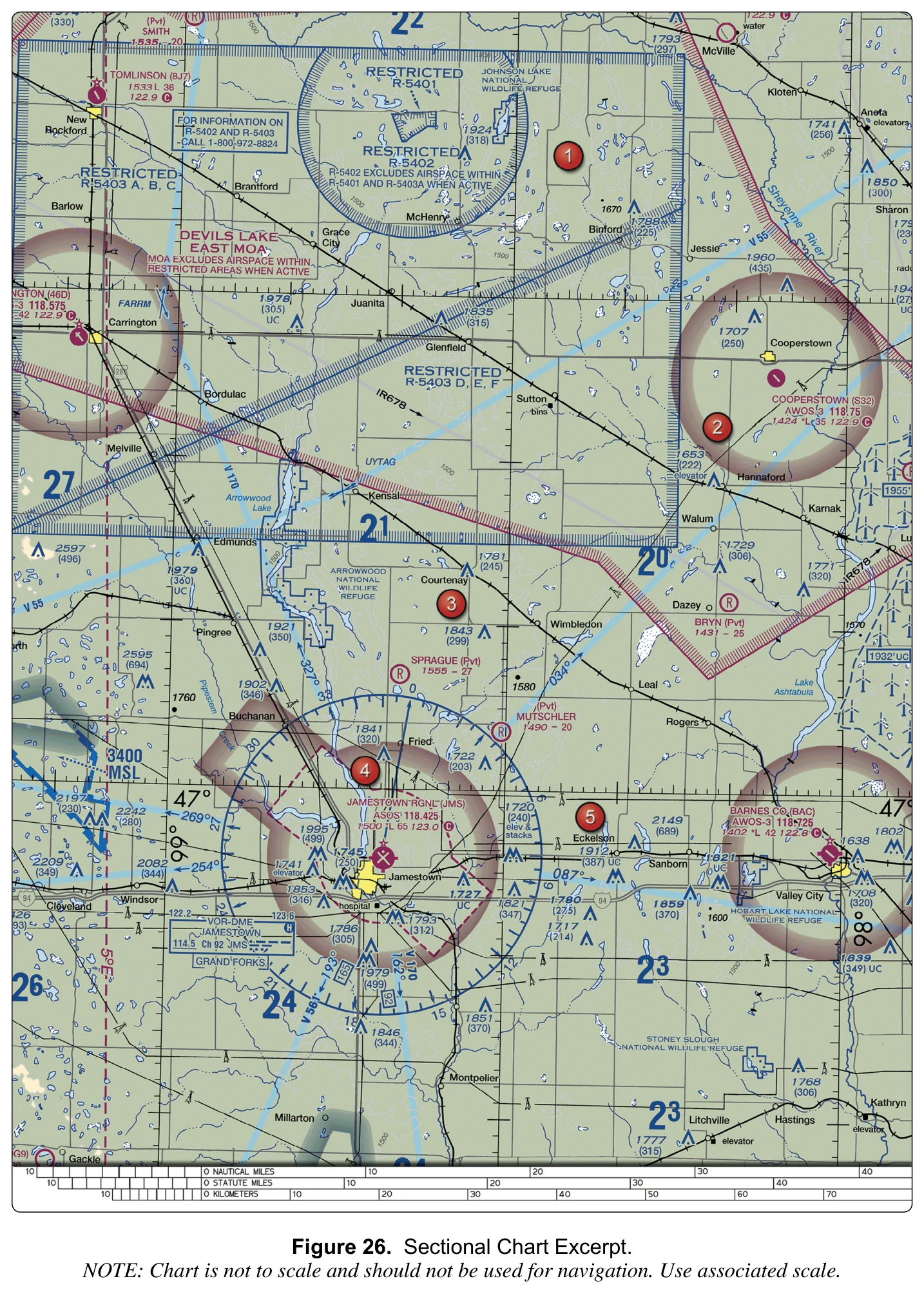
FAA-CT-8080-2H, Figure 26. This is a published testing-supplement figure, not a current navigation chart. Select to enlarge; source: FAA testing supplement.
Near Carrington, find the obstacle labeled 1978 (305), with UC beneath it. The top elevation is 1,978 feet MSL; the parenthesized height is 305 feet AGL. UC means under construction or reported, with position and elevation unverified. Keep the units attached to the numbers: choosing 1,978 feet as the structure’s height above ground would confuse the two references (Chart Users’ Guide, p. 11; FAA-CT-8080-2H, Legend 1).
Example 2: find CTAF in a dated sectional excerpt
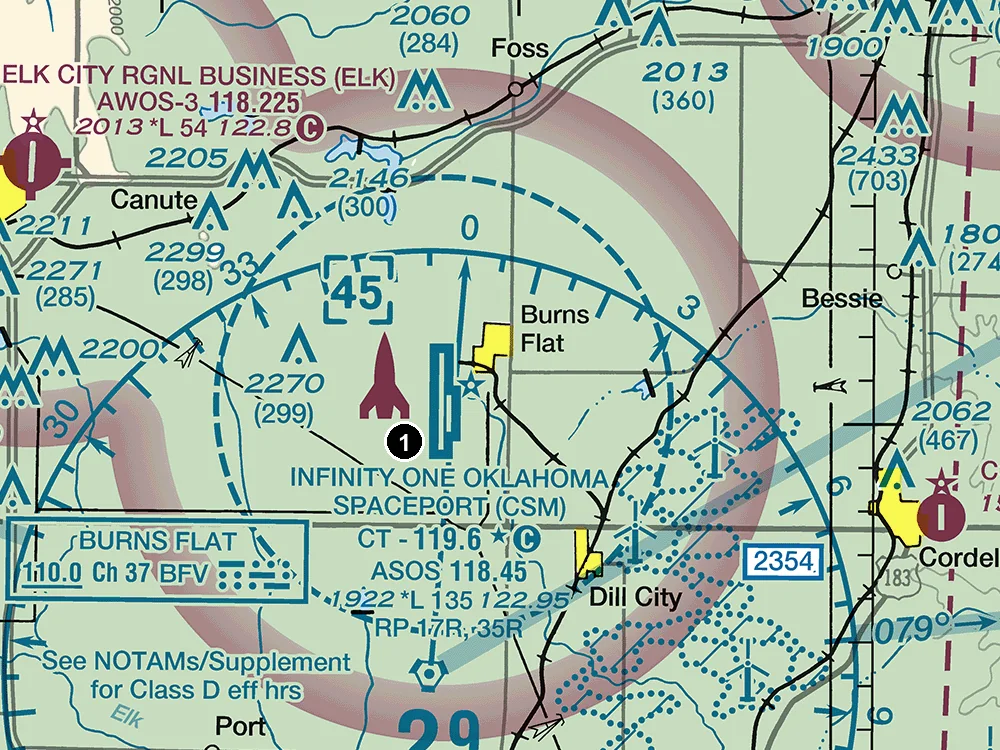
FAA Dallas-Ft Worth Sectional, September 3, 2026 edition, around INFINITY ONE OKLAHOMA SPACEPORT (CSM). The numbered marker was added for practice. Source: FAA VFR raster charts.
If the prompt asks which frequency is marked as CTAF for monitoring traffic when the tower is closed, read the circled C beside 119.6: 119.6 MHz. The star identifies a part-time tower. 118.45 is labeled ASOS, and 122.95 is in the UNICOM field; neither replaces the marked CTAF in this excerpt (FAA-CT-8080-2H, Legend 1).
Tower closure is a separate airspace question: Class D may revert to Class E or Class G, as published in the Chart Supplement. Do not infer the new class from the frequency alone (AIM 3-2-5). The CTAF and UNICOM guide walks through those labels, while the sectional chart guide explains AGL, MSL and airspace boundaries.
The September 29, 2025 weighting change
On September 29, 2025, the results of an assessment of the UAG exam, carried out by PSI with the FAA and the aviation industry, took effect. This made the test blueprint in the Remote Pilot ACS (FAA-S-ACS-10B) obsolete, and the FAA tells applicants to use PSI’s UAG Applicant Information Bulletin until the ACS is updated (ATCA, August 2025, p. 3). Current shares of the test, with the old ACS ranges for comparison (PSI UAG bulletin, p. 4; ACS, p. A-1):
- Regulations (UA.I): 48% (previously 15–25%)
- Airspace Classification and Operating Requirements (UA.II): 20% (previously 15–25%)
- Weather (UA.III): 5% (previously 11–16%)
- Loading and Performance (UA.IV): 2% (previously 7–11%)
- Operations (UA.V): 25% (previously 35–45%)
The percentages come from an industry-wide job task analysis completed in 2025 (PSI UAG bulletin, p. 4). On 60 scored questions they work out to roughly 29, 12, 3, 1 and 15 questions; that is our arithmetic, not an FAA figure. The ACS PDF still prints the old ranges in its Appendix 1, so use the bulletin’s numbers.
The FAA also said that the UAG test topics and subject matter did not change, that there is no reduction in test time, and that applicants should continue to use the ACS as a guide for testing resources (ATCA, August 2025, p. 4).
Validation questions
In addition to the 60 scored questions, you answer 5 validation questions. They are not scored, and the 120 minutes include time to answer them. They let the FAA check how new questions perform before they join the scored sets (PSI UAG bulletin, p. 4). The bulletin does not say which questions are unscored, so give every question the same care.
Question style updates announced in 2025
In February 2025 the FAA announced that it is updating pilot and mechanic test questions to a new format (ATCA, February 2025, pp. 3–4):
- airport names in questions that refer to a supplement figure follow the name and identifier format of the sectional chart;
- questions are presented in the third person (“the pilot” instead of “you”);
- questions with negative phrasing such as “Which of the following is NOT correct?” are removed;
- each question asks for a single response instead of offering “both” or “neither”.
Other updates worth knowing
- Part 108 is still a proposal. As of October 8, 2026, the Federal Register lists only proposed-rule documents for the beyond-visual-line-of-sight rule, starting with the August 7, 2025 proposal, and eCFR has no text for 14 CFR part 108. The ACS tells applicants to answer each question in accordance with the latest regulations (ACS, p. A-4).
- New PSI portal. PSI is moving its certification exams to its Test Taker Portal; the FAA says exam content, standards, oversight and security remain unchanged (ATCA, September 2026, p. 4).
How to adjust your study plan
- Start with regulations. At 48%, regulations are almost half the test. The Part 107 rules summary and the regulations questions cover them with section numbers.
- Read real charts. Airspace is 20% of the test, and from October 26, 2026 some questions will show images from the latest sectional charts. Practice with the sectional chart questions and the airspace questions, and keep the FAA Aeronautical Chart Users’ Guide at hand for symbols.
- Keep operations strong. At 25%, the operations area of the ACS (radio procedures, airport operations, emergencies, decision-making, physiology, maintenance and inspection) still carries weight: operations questions.
- Do not skip the small areas. Weather (5%) and loading and performance (2%) are still on the test: weather questions and loading and performance questions.
- Practice against the clock. Our mock exam draws its 60 questions in the same 48/20/5/2/25 proportions (rounded to 29/12/3/1/15) with a running timer.
For later updates, check the advisories listed on the FAA Airman Testing page.
Free self-check: dates, format and chart reading
These original checks reinforce the published guidance. Open each answer after deciding.
Which date begins the added UAG chart-image questions: October 26 or October 27, 2026?
October 26, 2026. The September advisory repeats the corrected date. The date for removing printed testing supplements is still unset (FAA ATCA, September 2026, pp. 5–6).
Do the five unscored validation questions add time beyond the two-hour limit?
No. The 120-minute allowance includes the 60 scored questions and 5 unscored validation questions (PSI UAG bulletin, p. 4). Our 60-question mock exam practices the scored-question format; it does not simulate the extra validation questions.
In the CSM excerpt above, which symbol selects the traffic-monitoring frequency?
The circled C beside 119.6 MHz. Read the symbol beside the number, rather than selecting ASOS 118.45 or UNICOM 122.95 because it is nearby (FAA-CT-8080-2H, Legend 1).
Put the change into practice with the free sectional chart questions, then take the free 60-question mock exam. For the airport subjects behind the images, continue with airspace classes, CTAF and UNICOM frequencies and airport traffic patterns.